The Cycle of Molecular Assembly
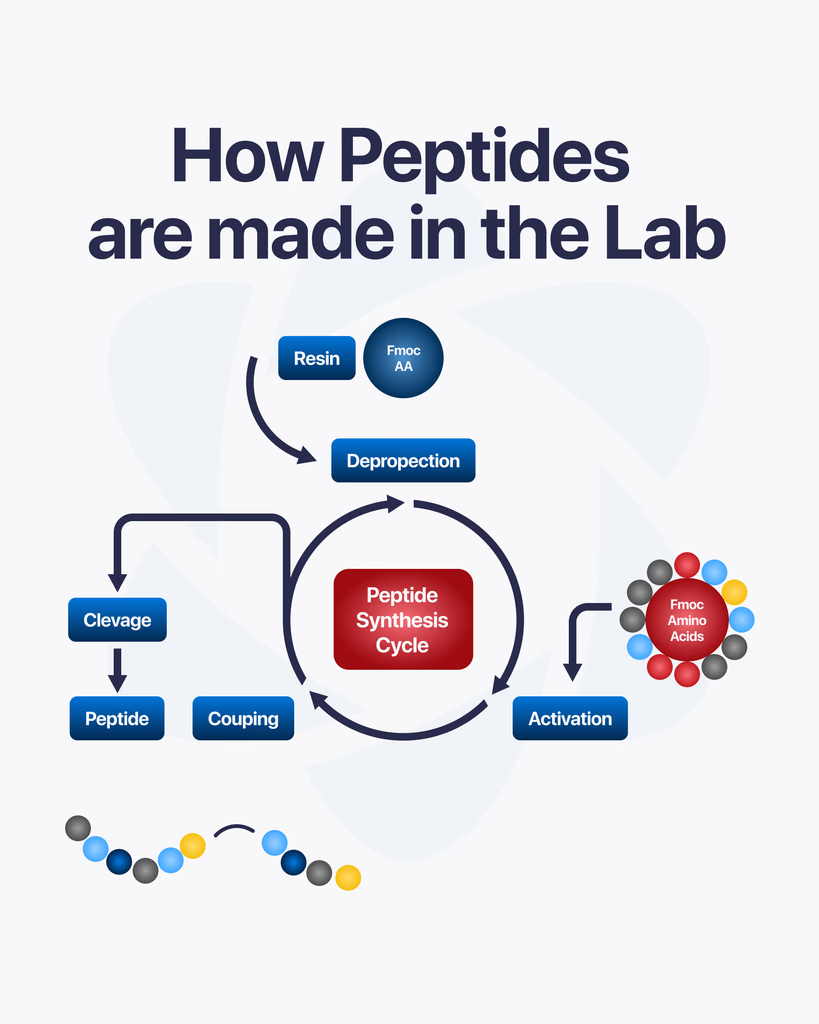
Peptide synthesis is the production of peptides, where multiple amino acids are linked via amide bonds. The process involves the systematic addition of amino acids to form a specific sequence under highly controlled conditions.
The Cycle of Synthesis
- Activation: The carboxyl group of the incoming amino acid is activated.
- Coupling: The activated amino acid is joined to the growing chain anchored to a resin.
- Deprotection: Protecting groups are removed to allow the next bond to form.
Solid-Phase vs. Liquid-Phase
Solid-Phase Peptide Synthesis (SPPS) is currently the gold standard, allowing for rapid synthesis and easy purification. **Liquid-phase synthesis** is typically reserved for large-scale production or specific short sequences where intermediate purification is critical.
Scientific References:
[1] Merrifield, R. B. (1963). "Solid Phase Peptide Synthesis. I. The Synthesis of a Tetrapeptide." Journal of the American Chemical Society.
[2] Fields, G. B., & Noble, R. L. (1990). "Solid phase peptide synthesis utilizing 9-fluorenylmethoxycarbonyl amino acids." International Journal of Peptide and Protein Research.