1. Introduction
Peptide-based therapeutics have emerged as a rapidly expanding field in regenerative medicine. Among the most extensively studied regenerative peptides is Thymosin Beta-4 (Tβ4), a naturally occurring peptide consisting of 43 amino acids that plays critical roles in tissue maintenance and cellular repair.
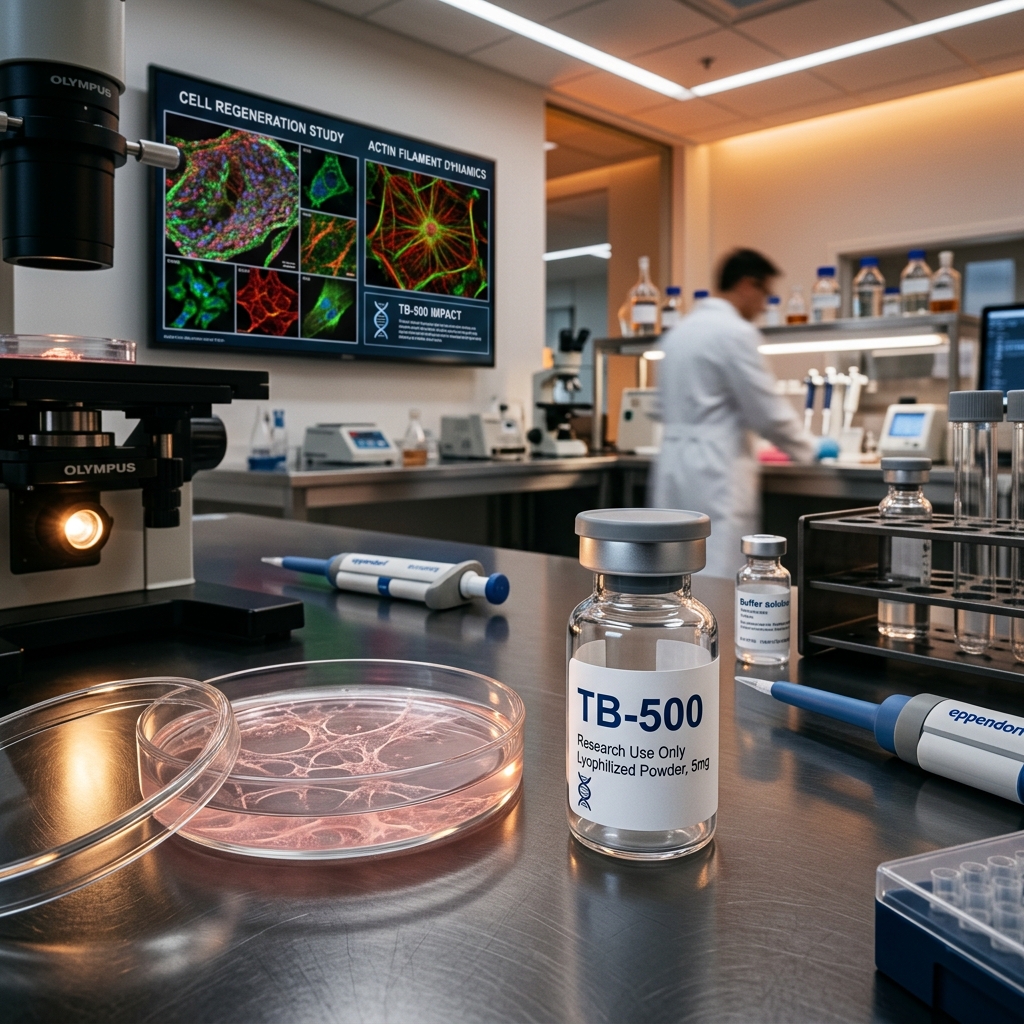
TB-500 is a synthetic peptide fragment designed to mimic the biological activity of Thymosin Beta-4 while providing favorable pharmacological properties. Research over the past two decades has demonstrated that TB-500 may influence multiple repair mechanisms throughout the body, making it a promising candidate for musculoskeletal recovery, tissue regeneration, and wound-healing applications.
2. Molecular Structure and Characteristics
TB-500 is derived from the active region of Thymosin Beta-4, a naturally occurring peptide widely distributed in mammalian tissues. Naturally expressed in platelets, macrophages, endothelial cells, and various tissues, Thymosin Beta-4 is highly conserved among vertebrate species and is involved in cell migration, tissue regeneration, angiogenesis, anti-inflammatory responses, and cytoskeletal organization.
3. Mechanisms of Action
The biological effects of TB-500 appear to involve several interconnected pathways.
3.1 Actin Regulation
One of the most important functions of Thymosin Beta-4 is its interaction with G-actin (globular actin). By regulating actin polymerization, TB-500 may facilitate cell migration, tissue remodeling, wound closure, and structural repair processes. Enhanced cellular mobility is considered a central mechanism underlying its regenerative effects.
3.2 Angiogenesis Promotion
TB-500 has been shown to stimulate new blood vessel formation in damaged tissues. Potential mechanisms include upregulation of VEGF signaling, increased endothelial cell migration, and enhanced capillary formation, which can accelerate nutrient delivery and tissue recovery following injury.
3.3 Inflammation Modulation
Studies suggest that TB-500 may help regulate inflammatory responses during tissue repair, leading to reduced inflammatory cell infiltration, decreased expression of pro-inflammatory mediators, and an improved overall healing environment.
3.4 Stem Cell Recruitment
Research indicates that Thymosin Beta-4 may influence progenitor and stem cell activity, enhancing stem cell migration and tissue-specific repair responses.
4. Biological Activities
4.1 Tendon and Ligament Repair
Musculoskeletal injury remains one of the most extensively studied areas of TB-500 research. Experimental studies have demonstrated accelerated tendon healing, enhanced collagen organization, increased tensile strength, and improved functional recovery, generating significant interest in sports medicine.
4.2 Skeletal Muscle Regeneration
TB-500 appears to support muscle recovery through multiple mechanisms, including increased muscle fiber regeneration, reduced fibrosis, and improved blood supply following trauma.
4.3 Wound Healing
Numerous studies have reported accelerated wound healing associated with Thymosin Beta-4 activity, demonstrating faster wound closure, enhanced epithelialization, improved collagen deposition, and reduced scar formation.
4.4 Cardiovascular Protection
Research has identified important cardiovascular effects associated with Thymosin Beta-4 signaling, including enhanced endothelial repair, reduced ischemic damage, and increased angiogenic activity.
4.5 Neuroregenerative Effects
Emerging evidence suggests that Thymosin Beta-4 may contribute to nervous system repair. Animal studies have reported improved neuronal survival, enhanced axonal growth, and reduced neuroinflammation following injury.
5. Clinical and Experimental Evidence
Animal models consistently demonstrate improved tendon healing, corneal epithelial repair, dermal wound healing, and myocardial repair through angiogenesis and activation of regenerative pathways. However, large-scale randomized human clinical trials remain limited.
6. Safety Profile
Current evidence suggests that TB-500 and its parent peptide Thymosin Beta-4 possess a favorable safety profile, showing low toxicity and good tissue tolerability in animal studies. However, comprehensive long-term human safety data remain insufficient, and potential concerns requiring further investigation include long-term angiogenic stimulation and dose optimization.
7. Current Research Limitations
Several limitations affect the current evidence base: most published findings originate from animal and laboratory studies rather than controlled human trials; there is variability in experimental protocols; and TB-500 is not currently approved by the U.S. FDA, remaining confined to research settings.
8. Future Perspectives
The broad biological activities of TB-500 continue to generate interest across sports medicine, chronic wound management, cardiovascular regeneration, neurorepair therapies, and tissue engineering. Advances in peptide delivery systems and clinical trial development may further clarify its therapeutic potential.
Conclusion
TB-500 represents a promising regenerative peptide derived from the naturally occurring protein Thymosin Beta-4. Preclinical evidence supports its involvement in tissue repair, angiogenesis, inflammation modulation, and cellular regeneration. While these findings are encouraging, well-designed human clinical trials are required to establish efficacy, optimal dosing strategies, and long-term safety.
Scientific References:
[1] Goldstein AL, Hannappel E, Kleinman HK. Thymosin Beta-4: Actin-Sequestering Protein Moonlights to Repair Injured Tissues. Trends in Molecular Medicine. 2005.
[2] Smart N, Risebro CA, Melville AA, et al. Thymosin Beta-4 Induces Adult Epicardial Progenitor Mobilization and Neovascularization. Nature. 2007.
[3] Sosne G, Qiu P, Christopherson PL, Wheater MK. Thymosin Beta-4 Suppression of Inflammation and Promotion of Corneal Wound Healing. Experimental Eye Research. 2007.
[4] Bock-Marquette I, Saxena A, White MD, Dimaio JM, Srivastava D. Thymosin Beta-4 Activates Integrin-Linked Kinase and Promotes Cardiac Cell Migration, Survival, and Cardiac Repair. Nature. 2004.
[5] Malinda KM, Sidhu GS, Mani H, Banaudha K, Maheshwari RK, Goldstein AL, Kleinman HK. Thymosin Beta-4 Accelerates Wound Healing. Journal of Investigative Dermatology. 1999.