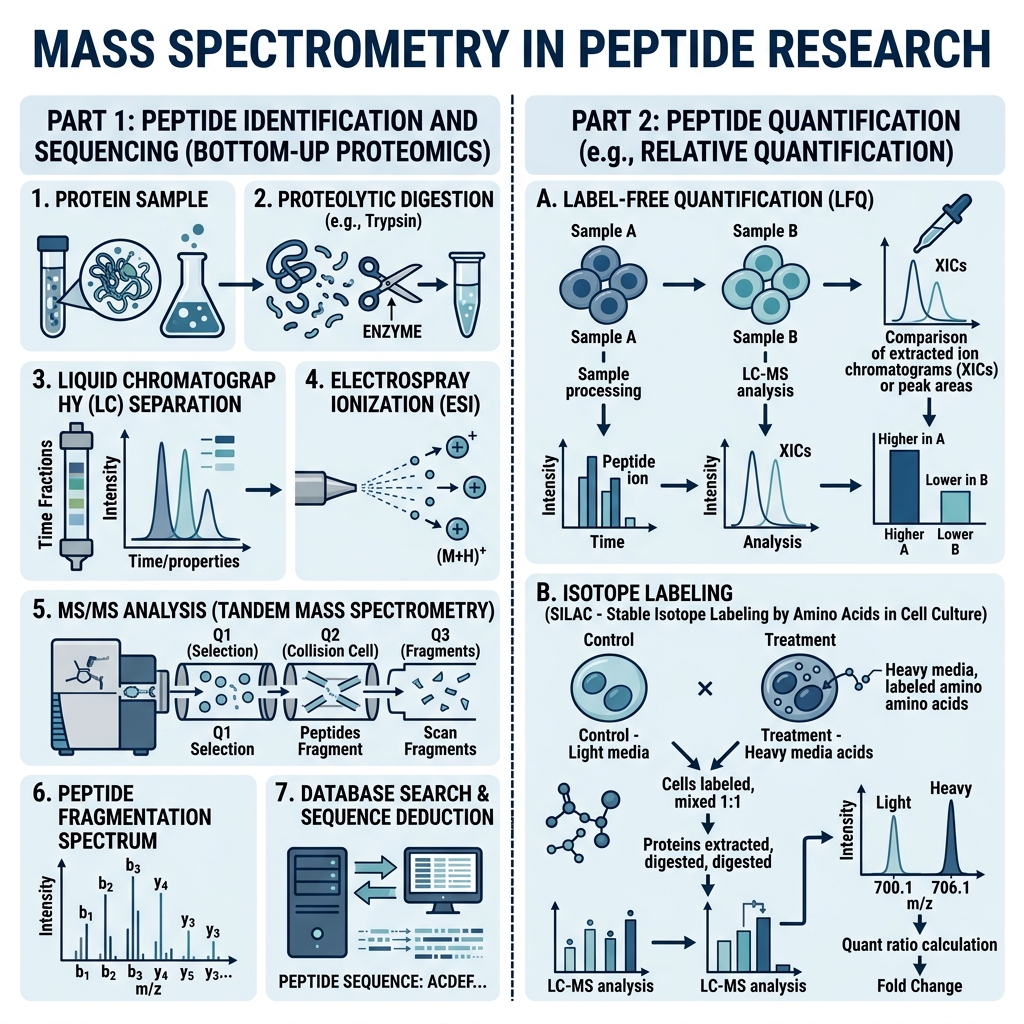
The Analytical Foundations of Peptide Purity
Mass spectrometry (MS) is an analytical technique that measures the mass-to-charge ratio of ionized molecules. By converting compounds into charged particles and separating them in an analyzer, MS allows researchers to determine molecular weights, identify unknown compounds, and analyze complex mixtures with high sensitivity.
Why Use MS in Peptide Research?
Peptides are small chains of amino acids that can vary in sequence, modifications, and purity. Mass spectrometry has become an essential tool for their study because it provides precise molecular information. Researchers use MS to:
- Confirm Identity: Measuring the exact molecular weight to ensure synthetic accuracy.
- Detect Modifications: Identifying post-translational or synthetic variations.
- Assess Purity: Detecting by-products and contaminants in synthetic preparations.
- Sequence Analysis: Fragmentation studies to map the amino acid sequence.
Common Methodologies
Several specialized methods are frequently applied in modern peptide analysis:
- MALDI-TOF: Matrix-Assisted Laser Desorption/Ionization—often used for rapid mass determination.
- ESI: Electrospray Ionization—allows for analysis in solution, ideal for liquid chromatography coupling.
- LC-MS/MS: Combines separation with fragmentation for high-fidelity structural sequencing.
Scientific References:
[1] Fenn, J. B., et al. (1989). "Electrospray Ionization for Mass Spectrometry of Large Biomolecules." Science.
[2] Tanaka, K., et al. (1988). "Protein and Polymer Analyses up to m/z 100,000 by Laser Ionization Time-of-flight Mass Spectrometry." Rapid Communications in Mass Spectrometry.