What is Lyophilization?
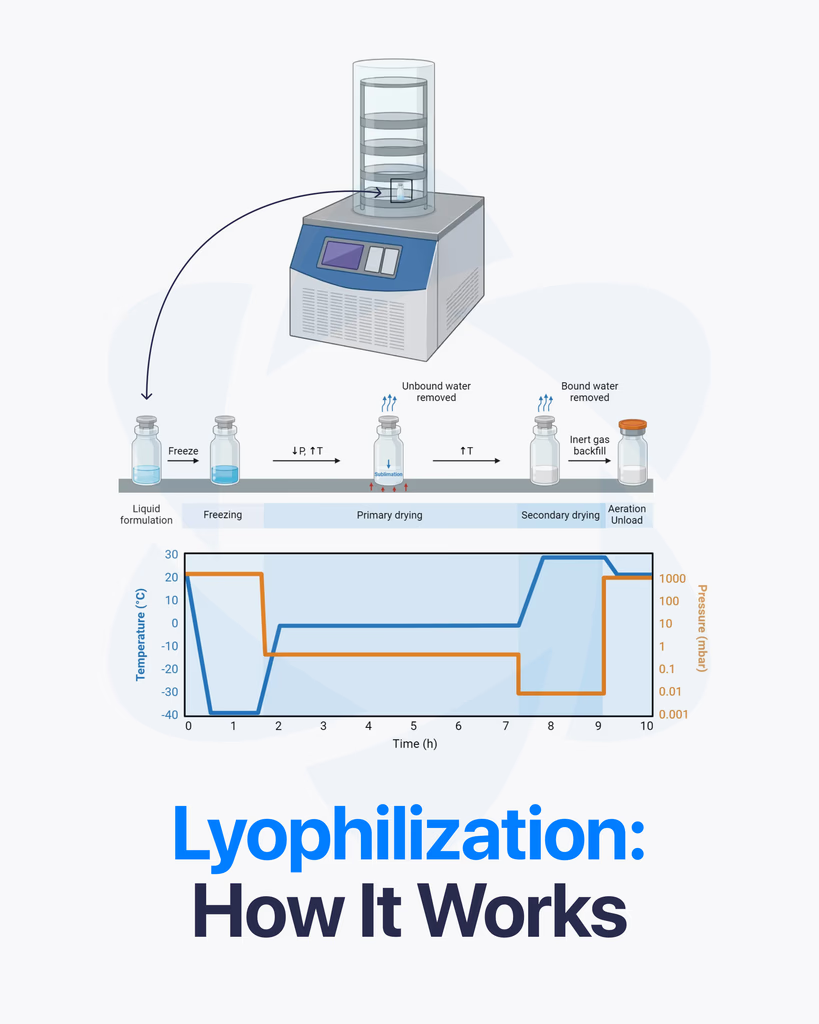
Lyophilization, also known as freeze-drying, is a dehydration process used to preserve perishable materials or make them more convenient for transport. It works by freezing the material and then reducing the surrounding pressure to allow the frozen water in the material to sublimate directly from the solid phase to the gas phase.
The Three-Step Process
- Freezing: Cooling the sample until water turns to ice, creating a stable solid matrix.
- Primary Drying (Sublimation): Lowering pressure and applying gentle heat to cause ice to turn into vapor without melting.
- Secondary Drying (Desorption): Removing bound water molecules to reach ultra-low moisture levels.
Why Researchers Use Lyophilization?
This method is vital for compounds like peptides that are unstable in liquid form. It minimizes degradation, extends shelf life, and allows for precise reconstitution for experimental use.
Scientific References:
[1] Franks, F. (1998). "Freeze-drying of bioproducts: putting principles into practice." European Journal of Pharmaceutics and Biopharmaceutics.
[2] Tang, X., & Pikal, M. J. (2004). "Design of Freeze-Drying Processes for Pharmaceuticals." Pharmaceutical Research.