Understanding the Growth Hormone Axis
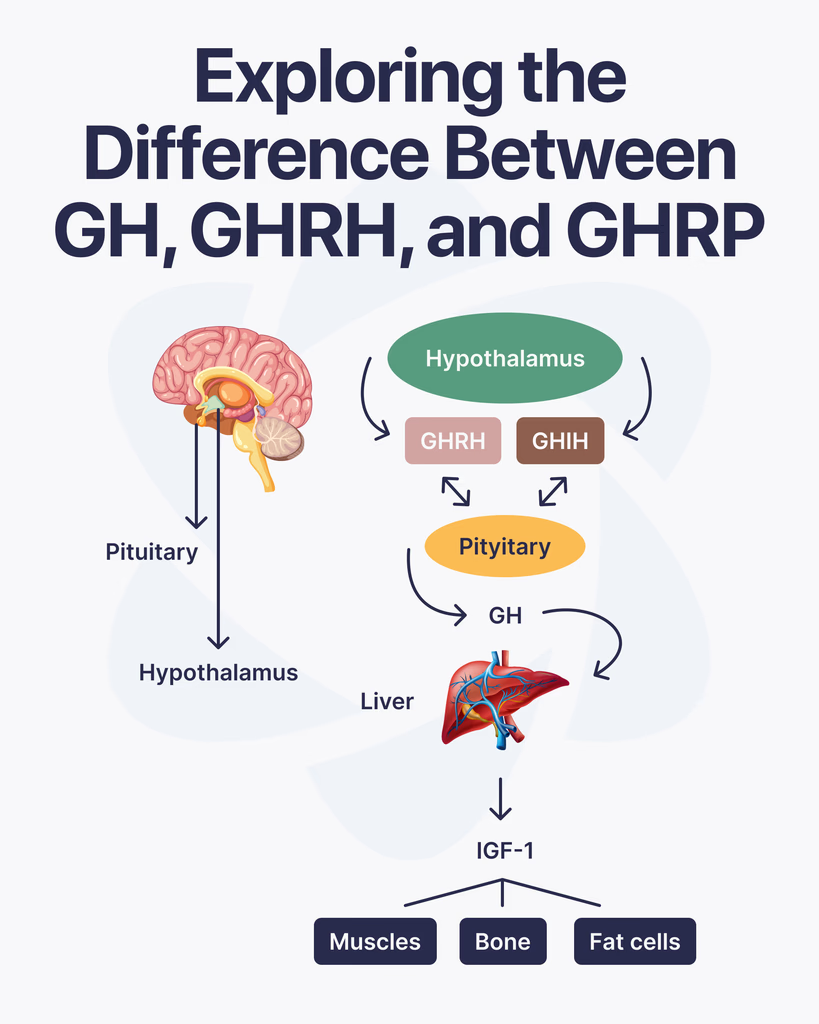
To understand the difference between these compounds, one must look at the hypothalamic-pituitary axis. While they all play a role in growth hormone levels, their mechanisms of action are distinct.
Growth Hormone (GH)
Growth Hormone, or somatotropin, is the end-product secreted directly by the pituitary gland. It regulates systemic growth, metabolism, and cell repair across various tissues.
GHRH (Growth Hormone Releasing Hormone)
GHRH is a natural hypothalamic peptide that signals the pituitary to release GH. In research, synthetic analogs like CJC-1295 are often studied for their ability to trigger natural, pulsatile GH release through specific GHRH receptors.
GHRPs (Growth Hormone Releasing Peptides)
GHRPs are synthetic secretagogues (like Ipamorelin) that stimulate GH release via GHS-R1a receptors. These are distinct from GHRH receptors and represent a different layer of regulation, often bypassing the traditional hypothalamic feedback loop.
The Key Distinction
The primary difference lies in the signaling pathway: GH is the hormone itself, whereas GHRH and GHRP are regulatory stimulants that act as triggers, each utilizing a different biological "key" to unlock the body's hormonal potential.
Scientific References:
[1] Bowers, C. Y. (1998). "Growth Hormone-Releasing Peptides: Structure-Function Relationships." Frontiers in Neuroendocrinology.
[2] Smith, R. G., et al. (1997). "Peptidomimetic Regulation of Growth Hormone Secretion." Endocrine Reviews.